

Donald Towns never wanted to work for Disney.
Standing in his studio today, surrounded by canvases that capture fleeting moments of light on everyday objects, the 35-year animation veteran laughs at the irony. “I wasn’t interested at all,” he admits, brush in hand, working on a piece where afternoon sun transforms an ordinary leaf into something extraordinary.
But before we get to Disney, before the eleven years painting backgrounds for some of the world’s most beloved animated films, we need to go back to a high school classroom in Atlanta, where a teenage Towns sat riveted by something unexpected.
His architectural drafting teacher had brought in a personal project—an unfinished painting he was struggling to complete. While other students bent over their technical drawings, Towns couldn’t look away. “I asked him so many questions,” Towns remembers. “I didn’t even know he was a painter.” That moment lit a fuse that’s still burning today.
At thirteen, Towns had already declared art would be his life’s work. But painting? That was a revelation that came later, sparked by that teacher’s canvas propped against a drafting table. After graduation, summer portrait artists nudged him toward the American Academy of Arts in Chicago. Architectural illustration seemed practical, sensible. It landed him in Sherman Oaks, California, sharing an apartment with another artist named Thomas Blackshear.
Here’s where fate gets pushy.
Blackshear kept insisting Towns had Disney-level talent. Towns kept declining. So Blackshear did what any good friend would do—he smuggled Towns’ portfolio to his own Disney interview. “I gave in with no thoughts of anything becoming of it,” Towns says. “Then Disney called.”
Theatrical Light, Personal Vision
Eleven years at Walt Disney Animation taught Towns to see light differently. Not just as illumination, but as what he calls “an unconsidered object of composition”—a character in its own right that guides viewers through painted worlds. Animation demands theatrical lighting, dramatic moods, endless variety. These lessons sank deep into Towns’ artistic DNA.
Now, decades later, those Disney years infuse everything he creates. His style occupies what he calls “a middle ground between realism and impressionist representational art.” Sometimes viewers mistake his paintings for photographs, yet there’s a looseness, an emotional quality that no camera could capture.
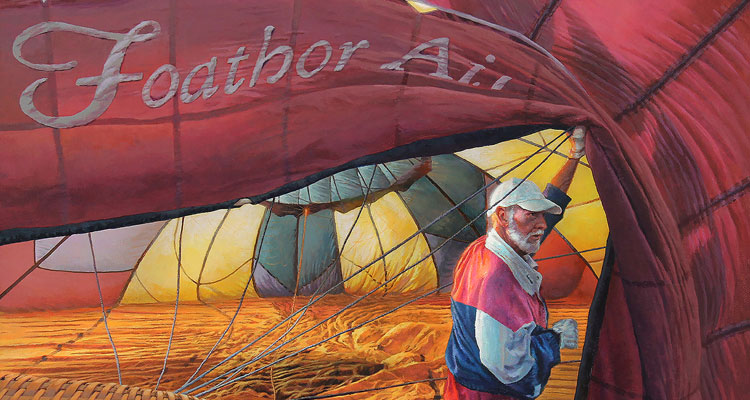
His upcoming exhibit, Depicting the Moment, (Piedmont Arts October 25-January 10, 2026), showcases this evolution. The title reflects his philosophy: paint whatever inspires in that instant, whether it’s weathered architecture bathed in golden hour light or grandchildren reading on a couch.
That last image became “Eden Restored,” perhaps the exhibition’s most personal piece. Towns’ son snapped a photo of the grandkids absorbed in a digital tablet, light spilling across their faces. Something about that moment triggered a memory of Isaiah 11:6-9—the biblical vision of children playing safely with wild beasts in a restored paradise.
“Quite a joy having the grandchildren as subjects,” he says softly, the professional artist giving way to the grandfather.
The Challenge of Success
Preparing for Depicting the Moment brought unexpected complications. Towns’ work is in such demand that newer pieces are already committed to overlapping exhibitions. It’s a good problem to have, but it narrowed his choices considerably. As acting Vice President of the Tehachapi Arts Commission and an active California Art Club member, his calendar resembles a complex animation production schedule.
The irony isn’t lost on him. The man who reluctantly entered animation now can barely keep up with demand for his fine art.
“I believe beauty can be found in unexpected places and subjects,” Towns explains, mixing colors on his palette with the precision of someone who’s spent decades getting it exactly right. “Whether those moments are fleeting or long lasting, they can bring awe, joy and inspiration to our lives.”
His next goal? Joining Oil Painters of America for their 2026 national shows. It means producing more paintings at an even higher quality. “That alone gets me excited,” he grins, sounding like that thirteen-year-old in Atlanta who decided art would be everything.
Thomas Blackshear—the roommate who wouldn’t take no for an answer—remains his unofficial benchmark. “When I see the quality of his work, it pushes me to strive for that level in mine.”