

Not long ago, I was lined up to be the guest soloist at Danville’s Trinity United Methodist Church. This was not something new to me, as I have enjoyed such brief Sunday “song sojourns” to other churches over the years. I have enjoyed the people I met; and they seem to have enjoyed me. The minister of Ringgold Baptist Church has baskets of his home-grown tomatoes for his congregation; and so far, none of his members have felt the urge to pick up one and hurl it at me after I’ve sung.
Trinity’s choir director had called me just a few days before my solo to tell me she was experiencing some medical issues; but that she would be at church early to practice with me, hoping her fingers would cooperate. She said I might have to sing a cappella (not the Barney Fife variety. I told her, “I hope I don’t have to do that.” Adding, “I mean this not in relation to me, but in hopes for you!”
I arrived at the church early that morning. And it was a good thing the congregation was not yet in attendance. Because after striding down the aisle towards the lectern, where I would be singing, I tripped on the first carpeted, ascending step. But my nose did not meet the carpet like it met the sidewalk outside of my home church of Danville’s First Presbyterian, last year.
This church does not have snare drums and cymbals, though there is nothing wrong with having such musical instruments in church. But if they did, something like a brief snare drum roll and a rimshot or bass drum “thud” would have been appropriate for my tripping and falling.
Our rehearsal went extremely well. The pianist’s fingers were as nimble as when I’d heard her many times before down in North Carolina at Yanceyville’s Prospect Methodist Church.
During the service, my solo went well. But that is not the major theme of this article. And the minister delivered a marvelous sermon. But even that is not what I wish to point out here.
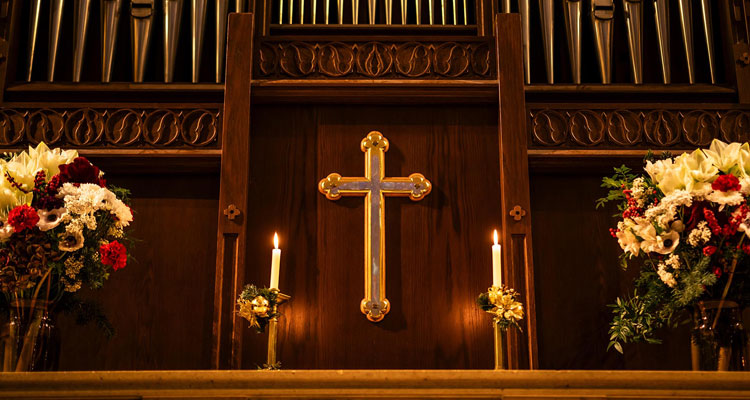
The crux of the matter has to do with the acolyte who lit the candles on either side of the Cross at the beginning of the Service.
Starting at the back of the church, a young lady with Down syndrome began making her way down the aisle, with her candle lighter/ snuffer held high. Her disability added some difficulty to her professional; but there was a force of dogged determination in her step; and I think the gripping of that candle-lighting device was a steadying factor, kind of like the pole held by the high-wire walker.
When she reached the altar steps, a deacon held her arm as she carefully ascended (including that same step upon which I had earlier tripped).
For my solo, I was seated behind the altar, to one side, and on a raised level. Because of this, I could look down into the young lady’s eyes as she sought to successfully touch her bright flame to the cold, dark, dead candle wick.
Neither the difficulty of the young lady’s march up the aisle, nor the guiding of flame to wick gave rise to even the least look of pained concentration upon her face. There was only the look of peaceful determination, with no furrowing of brow, nor down-curling of lip to mar it.
The acolyte’s steadied gaze during her task reminded me of that same, “spot on” look of concentration displayed in the eyes of the laboratory scientist, when pouring the contents from one beaker to the next, or the careful manipulation of a slide rule.
No one else was standing there with me in that straight-on, “line of sight” alignment to see what I saw in the acolyte’s eyes.
It is often said that Winston Churchill was meant to be the prime minister of Great Britain during World War II. Well, I think all of us, not just those striders of the world stage, are meant to be in particular places many times during the course of our lives.
It’s as if I were meant to be in that particular spot on that particular morning, so I could see, and then tell you.