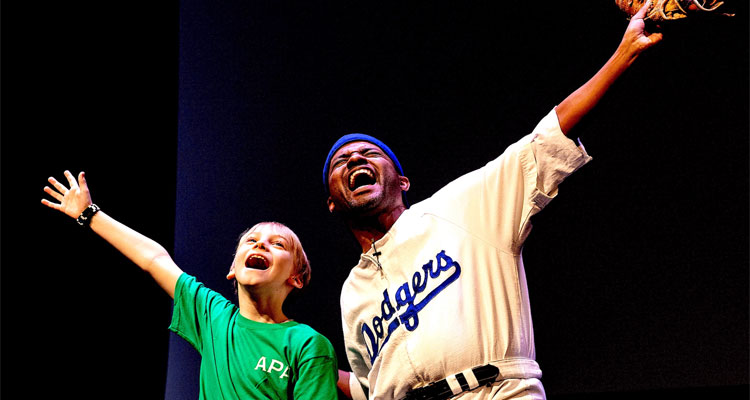

When Mike Wiley takes the stage at Piedmont Arts in Martinsville on March 26, he won’t just be performing a one-man show about baseball legend Jackie Robinson. He’ll be coming home. A Roanoke native, Wiley has spent decades transforming historical narratives into visceral theatrical experiences. For him, the stage has never been merely a platform for performance—it’s a bridge spanning the chasm between dusty textbook pages and the urgent pulse of the present.
Wiley’s journey into storytelling began with listening. Long before he commanded stages, he was captivated by the way history lived within people—how they talked, how they held their silence, how they carried the weight of their experiences. “Theatre gave me the vessel to take those observations and give them form,” Wiley explains. He realized early that performance could bridge lived experience and imagination, and today he uses one-person theatre to invite audiences to “sit with” stories that are as challenging as they are vital.
Jackie Robinson: A Game Apart is naturally centered on baseball, but Wiley clarifies that the sport is merely the “doorway” to something deeper. “The heart of the play lies in the immense moral weight Jackie Robinson was forced to carry while being told not to respond to the injustice surrounding him,” he says. Robinson and other athletes of that era were asked to shoulder the weight of a nation’s conscience while being instructed not to respond in kind—a level of restraint Wiley describes as almost unimaginable.
During his research, Wiley delved into letters, speeches, and firsthand accounts to understand the physical and emotional toll of that silence—what it cost Robinson’s spirit and his family. “Robinson’s strength was not just physical or athletic,” Wiley emphasizes. “It was fundamentally moral.” What struck him most was how deliberate everything was in Robinson’s journey. “Nothing about Robinson’s path was accidental,” he says. This awareness deepened his respect for what Robinson endured long after the headlines faded.
What draws Wiley to these stories is the intersection of the ordinary and the extraordinary. “I find power in moments when ordinary people are asked to do extraordinary things under impossible pressure,” he reflects. History often gets flattened into dates and headlines, but human beings making hard choices lived those moments. And those choices still matter. “The questions they raise—about justice, restraint, courage, and responsibility—are not settled. We are still wrestling with these themes today.”
Theatre, in Wiley’s vision, provides a space for communities to slow down and examine those moments honestly, offering reflection without the modern noise of sound bites or slogans. This commitment to truth anchors his creative process. He begins with meticulous research, treating facts as non-negotiable bedrock. “The theatre’s primary role is to animate history books, not replace them,” he explains. By respecting the truth of the record, he ensures that when an audience finally feels a connection, it is because the truth has been honored.
As a solo performer, Wiley faces unique challenges. “There’s nowhere to hide,” he admits. “Every shift in voice or posture has to be earned through responsibility to the subject.” Yet this format creates an intimacy that ensemble work cannot achieve. It allows him to move between multiple voices and perspectives, letting audiences feel the emotional complexity of an era. The audience doesn’t just observe history—they sense how close these pivotal moments are to one another.
Robinson’s story challenges modern notions of heroism. “His courage was not loud; it was controlled,” Wiley observes. The play focuses on the tension between anger and discipline, asking audiences to reconsider what strength looks like when retaliation isn’t an option. This resonates deeply with contemporary audiences, particularly in moments where Robinson does not act. In a world that rewards instant reaction, Wiley views Robinson’s discipline as radical.
Audience engagement is crucial to Wiley’s work. When an audience leans in, the dynamic shifts—the actor transforms from someone talking at them to someone sharing space with them. This interaction drives home that Robinson’s journey isn’t something that happened “back then” to “other people.” The choices we make today—how we respond to injustice, how we treat one another—are part of a continuing story.
“Theatre is a tool for creating empathy in real time,” Wiley explains. “Strangers sit together, breathing the same air and listening to the same story.” This shared experience can open doors that lectures and textbooks sometimes cannot.
As he prepares for the Martinsville performance, Wiley is excited to perform where people can see themselves reflected in Robinson’s story. He views the audience not as spectators, but as participants in an ongoing conversation about courage, responsibility, and change. “For those attending my work for the first time, I hope they leave feeling connected—to history, to one another, and to their own capacity for empathy.”
If they walk out asking better questions or seeing familiar stories in a new way, “then the theatre has done its job.”
Jackie Robinson: A Game Apart
March 26, 2026
Piedmont Arts, Martinsville, Virginia
For tickets and information, visit piedmontarts.org