
The other day I was watching a YouTube video about people digging for 20th century relics, and thought about my son, Jeremy’s experience with digging in Danville a few years ago.
The site of his exploration was the small parking lot next to where he works, with the express permission of the property’s owner.
That parking lot needed much repair, as cracks and the result “frost heave” within had resulted in crumbling asphalt throughout.
Wind-blown plant seeds had found places to land, sprout, and take hold, their roots having ready access to the soil below, which “waited” (here, I’m perilously close to anthropomorphizing “dirt”).
The gentle “push” of plants working their way up from the soil had widened those fissures even more. The horsetail rush, “Equisetum,” had found a welcoming habitat there, some stalks achieving almost the height of a man. But this was still very shy of its ancestor, Calamites, which could reach 30 feet high, with a foot-wide trunk about 300-some million years ago! But the “yesteryear” of which I write, was only a few years ago, so let me return to that.
Jeremy’s initial digging was aided (but not purposefully) by a man from Danville Public Works operating a backhoe to remove the crumbling pavement.
After looking at old city maps of Danville, Jeremy learned several buildings had come and gone there; and in the intervening times, the space had been used as a “dumping ground.” And just as in the Holy Land, more recently discarded items were near the surface, with the older things deeper down.
Among the glass items Jeremy found, were an intact Danville-bottled Coca-Cola bottle, an old (old, goes without saying) Nu Grape Soda bottle, along with some wine bottles and many other containers, both whole and fragmentary. One bottle had the glass-formed name “Birely’s.” According to glass-formed numbers as to content, the bottle had once held 6 3/4 ounces of orange juice (I guess stomachs were a lot smaller then, inside and out).
Another item Jeremy found was a 10–12-inch diameter ceramic jar lid. It appeared to possibly be the lid of a cookie jar, but the rest of it never turned up. It was almost as if “the hands of time” had removed the lid of the cookie jar, but misplaced the container, along with the cookies. And even if the cookies weren’t eaten, they have long since been “consumed” (Biblical usage).
For locating metallic items, Jeremy used his metal detector. One of the most unusual items was musically reed shaped, and inscribed with the letter “G.” Jeremy deemed it to be the “note part” of a “squeeze box” (accordion). Sir Arthur Sullivan of “Gilbert and Sullivan” fame (not to be confused with the Irish song writer Gilbert O’Sullivan) composed the ever-popular tune, “The Lost Chord;” and I like to refer to this particular musical item, inscribed with the letter “G,” as “The Lost Note.”
I looked in that same old parking lot, finding a few bottles, including a nice-size wine bottle, an old ceramic canning lid insert, some pieces of a ceramic bowl or cup with painted flowers remaining, etc. I saw something round sticking out of the dug-up, piled soil; and when I extracted it, lo-and-behold, I was holding the handle of an old drinking mug! It was almost as if the mug handle was poking up just above the soil for the express purpose of enticing me to take hold.
But just as the bottom part of Jeremy’s cookie jar was missing, so was the rest of my drinking mug.
Not far away from where I found the mug handle was a hole about 2 inches wide, from which a single hornet was exiting; but I knew there were many more below! Sometimes, by chance, paleontologists are “aided” by fire ants bringing up and piling up ancient rodent bones encountered while constructing their nests. But no matter whether on purpose or by coincidence, I would decline such help from a hornet.
Of the old wine bottle I found, Jeremy said it possibly dated from the late 1800s because of the texture of the glass and the construction of its “dimple.”
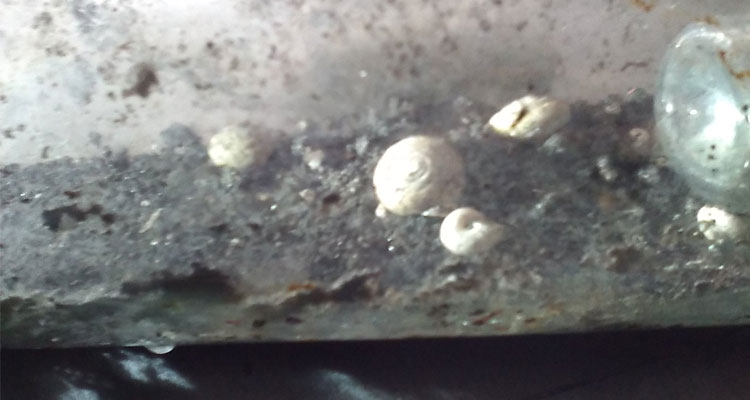
That wine bottle’s top was broken off, and the rest of the bottle was filled with soil. At the bottom of the wine bottle, next to the glass could be seen a large quantity of pale, spiral shells of long-dead land snails.
I left the soil and old shells inside that bottle, feeling that dumping them out would be like desecrating a grave site. And besides, when I look at those snail shells lying in the bottom of that old wine bottle, I recall some of my evenings as an early 1970s college student at Appalachian State University.
Jeremy also found some other metallic items besides that “G-note” with the use of his metal detector. There were some old square-headed nails and some corroded iron objects. But strangely enough, he only found one coin, but this coin was a 1929 penny!
I remember first reading about the Great Stock Market Crash of 1929 when I was in the upper grammar grades; but in a way, here it was, right before me. Judging from its depth in the soil, the coin may have actually been dropped not long after being minted. A lot of money was lost when the stock market crashed; but this piece of money was lost “physically.”
The little parking long has since been repaved. Whatever was not found by Jeremy, and to a much lesser extent, me, will have to wait for some time in the future, when others may have as exciting a time there as we did (for our “soil coverings” don’t last as long as those of the ancient Romans, and must needs be re-done from time to time).
And even though this was a re-opening of the ground to perhaps learn and find something new, it made me think of something far above, some of which periodically return, of which we learn some more about the universe at each approach: comets.
Thus, we learn, from soil and sky.