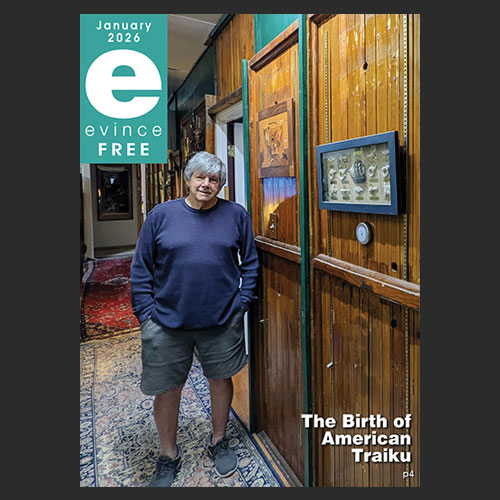

The 1885 Valley Line train station in Lexington, Virginia, seems an unlikely home for a photographer who spent decades navigating the frenetic pace of New York’s publishing world. But for Russell Hart, the converted depot represents something more profound than a simple change of address—it’s a return to roots, a quieter rhythm, and a creative renaissance that has redefined his artistic vision.
Hart’s latest exhibition at Piedmont Arts, “In a Different Light,” weaves together two disparate bodies of work: intimate black-and-white photographs from his mother’s house and surreal landscapes captured with infrared cameras. The juxtaposition reveals an artist grappling with memory, loss, and the endless possibilities of photographic seeing.
The Long Road Home
Hart’s journey to this moment began in Charlottesville, where his father taught at the University of Virginia. After starting college at Dartmouth, he transferred to a joint Tufts/Boston Museum School program that allowed him to pursue both academics and art. Photography emerged as his chosen medium—not just for its creative possibilities, but for its practical promise of making a living.
“Photography was the one medium that I realized I might be able to earn a living with,” Hart reflects. He built a successful career doing assignment work for Polaroid, Boston magazine, and the Boston Globe Magazine, while teaching photography at both Tufts and the Museum School.
But life had different plans. Hart found himself increasingly drawn to writing about photography rather than just making it. This shift led him to New York, where he became executive editor at American Photographer (later American Photo) for 25 years. The magazine, which he describes as a “visual culture” publication focusing on photographer profiles, photographic history, and art criticism, became his window into photography’s infinite forms.
“It was a real education, teaching me that photography can be all things to all people,” Hart says. During this period, he also authored several books, including Photography for Dummies and a college textbook, demonstrating his ability to translate complex photographic concepts for vastly different audiences.
The Catalyst of Crisis
About ten years ago, several converging forces pushed Hart back toward active art- making. A shift away from print publishing coincided with the decline of traditional camera manufacturing as smartphones began dominating the market. A two-week artist’s residency at the remote Isle Royale National Park reminded him of his comfort with nature as a subject and his enduring belief that beauty in photographs still mattered.
But perhaps the most significant catalyst was deeply personal: the need to empty his mother’s house after dementia made it impossible for her to live alone.
“My undertaking took the better part of two years,” Hart explains. “I spent nearly half that time living in the house alone, plowing from morning to night through rooms gorged doubly by outright hoarding and the Yankee custom of handing down meaningful objects.”
What he discovered was a Victorian house packed with four decades of accumulated life—everything from saved bits of string to a hand-woven wallet an ancestor had carried into the French and Indian War. His mother had organized much of it into hundreds of “trays”—cardboard boxes cut to precise heights—each containing groups of related items that had long outlived their usefulness.
Photography as Meditation and Medicine
Initially overwhelmed by the emotional weight of the task and daily visits to his mother’s memory care facility, Hart began photographing as he worked. “Thinking it might mitigate my grief and loneliness, I started taking pictures as I worked, though not for memory’s sake,” he explains.
The resulting images, collected in his book As I Found It: My Mother’s House, transform intimate objects into universal meditations on loss and memory. Working in black and white to avoid the visual distraction of mismatched colors, Hart photographed his mother’s carefully organized collections by the light of an attic window, using a meticulous technique that preserved every detail and tonal nuance.
“I did worry at first that the project’s photographs might be too personal to mean anything to viewers,” Hart admits. “They’re apparently meaningful to other people, who seem to be able to bring their own experience or understanding to what they’re seeing. Seeing people connect with the work in this way was healing and gratifying.”
Seeing in a Different Light
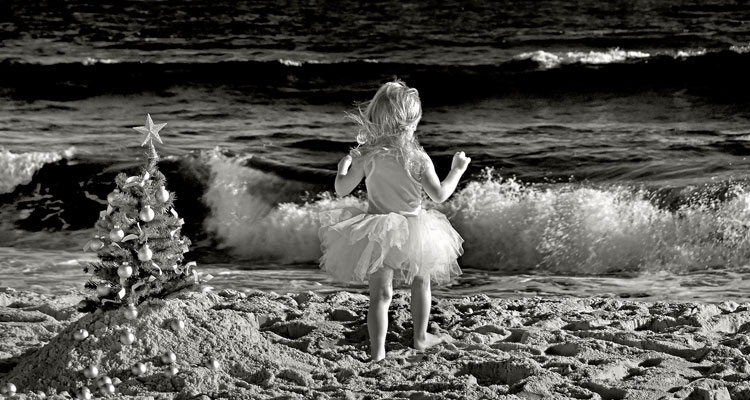
Hart’s landscape work, which comprises two-thirds of the Piedmont Arts exhibition, emerges from an entirely different photographic philosophy. These images, created with cameras converted to capture infrared radiation, transform familiar scenes into otherworldly visions where grass appears luminous white and skies turn dramatically dark.
“I’ve always been very interested in what humans do to the landscape, good and bad, for practical, recreational, and even decorative purposes,” Hart explains. His approach is observational rather than judgmental—he’s not making environmental statements but piquing curiosity about the ways humans occupy and alter their surroundings.
The infrared technique creates what Hart calls “a formula for surrealism,” though he traces his aesthetic lineage to Pictorialism, the late 19th and early 20th-century movement that favored expression and mood over pure realism. The results are photographs that feel simultaneously familiar and alien: a picnic shed at White Sands National Monument rendered ghostly and vacant, or a life-sized dinosaur sculpture creating an anachronistic dialogue with Natural Bridge.
Hart’s process involves finding interesting settings, establishing compositions, and then waiting for something to animate the scene. During a recent trip to Cornwall, he photographed cows crossing a field around an ancient standing stone, initially attracted by the juxtaposition of the prehistoric monument with modern plastic-wrapped hay bales. When he noticed cows approaching, he repositioned himself to capture them studying him curiously as they moved across the frame.
The Zone of Creative Seeing
“When I’m out looking for photographs—and most of the time it’s just looking, since I can travel for quite a long time without actually taking a photograph—I find myself in a zone,” Hart describes. “It’s a kind of moving meditation. Everything else, whether bad or good, just seems to leave my head.”
This meditative quality permeates both bodies of work in the exhibition. Whether documenting his mother’s archived possessions or waiting for serendipitous moments in the landscape, Hart embraces a patient, observational approach that allows scenes to reveal their hidden poetry.
His travels have taken him from the relative sparseness of Nova Scotia to the abundant flatness of Florida, from Cornwall’s ancient stone circles to the back roads of the American South. Each destination offers new opportunities for what he seeks: surprise, incongruity, and moments of unexpected revelation.
Synthesis and Future Directions
The decision to combine these two bodies of work in a single exhibition might seem risky, but Hart sees subtle connections between them. Both rely on careful observation, though one documents the deeply familiar while the other explores typically unfamiliar territory. Both exist in full-toned black and white, and both show his belief that an artist’s work need not be slavishly consistent.
“I think a slavish consistency can make the creation of art less inspiring and exciting for both artist and viewers,” Hart argues. “I think it’s okay and even beneficial to the artist to create different kinds of work—there are often subtle connections between them—and one kind of work can actually inspire other bodies of work.”
The As I Found It project led Hart to create Microcosm, a series of large-scale color panoramic prints of tiny-scale objects, some discovered while clearing his mother’s house. The work operates at an even more intimate scale than his mother’s organized boxes, demonstrating how one body of work can germinate entirely new creative directions.
The Gift of Place
Now settled back in Virginia after decades in New York, Hart speaks warmly of the state’s “wonderful, patchwork network of back roads” and the more relaxed, friendly culture. His return to Virginia represents more than a geographic relocation—it’s a creative homecoming that has allowed him to pursue his art with renewed focus and purpose.
At Piedmont Arts, Hart is grateful for the opportunity to present a substantial solo exhibition, particularly after the competitive challenges of showing work in New York and New England. “The opportunity to have a substantial one-person show is rare,” he acknowledges. “It’s really valuable artistically to have to put together a consistent and/or meaningful collection of work; it forces you to reassess what you’ve been doing and make connections and draw conclusions.”
Looking ahead, Hart plans to continue his landscape photography, with destinations ranging from Portugal to Newfoundland calling to him. He’s also exploring other ongoing bodies of work, including color panoramic still life and black-and-white plant studies, while returning to drawing, printmaking, and painting after years of focus on photography.
Light and Shadow
Hart’s career exemplifies photography’s capacity for reinvention and discovery. From commercial assignment work to magazine editing, from writing instructional books to creating deeply personal art, he has inhabited nearly every corner of the photographic world. His current work synthesizes decades of experience into a mature vision that finds poetry in both profound loss and unexpected moments of beauty.
“In a Different Light” serves as both title and philosophy, inviting viewers to see familiar things in new ways, to be surprised by the unexpected, and to find meaning in the juxtaposition of seemingly unrelated elements. Whether documenting a mother’s carefully preserved archive or capturing the surreal dialogue between ancient stones and modern intrusions, Hart’s photography suggests that revelation often comes not from seeking the extraordinary, but from learning to see the ordinary with extraordinary attention.
In an age of instant digital imagery and constant visual noise, Hart’s patient, meditative approach offers something increasingly rare: the invitation to slow down, to look carefully, and to discover that the world—even in our darkest moments—still holds surprises worth preserving in light.