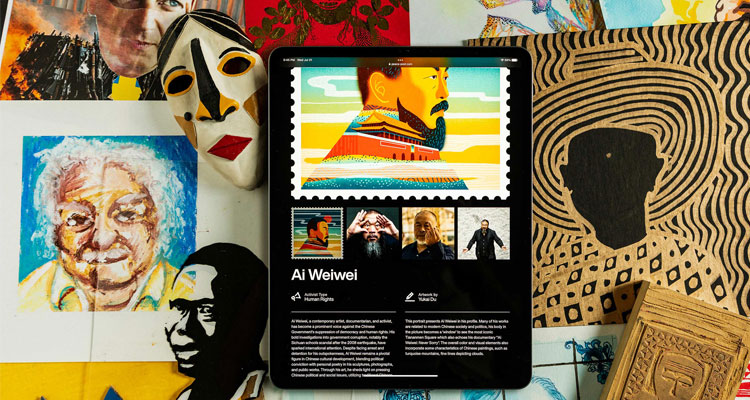


After eight years of painstaking research and collaboration with over 100 artists worldwide, Johnny Selman’s Peace Post project—a collection of 198 digital stamps honoring peace advocates from every sovereign nation—is finally complete. It’s been many miles from Martinsville, Virginia, where his creative journey began.
Small-Town Roots, Big-World Vision
Growing up in 1980s Martinsville, Selman belonged to what he calls the “Oregon Trail Generation”—kids who spent hours in school computer labs, blissfully unaware of how technology would reshape their futures. Without constant digital distractions, Johnny and his friends transformed their small Southern town into whatever their imaginations demanded.
“We were free to roam the neighborhood and fight invisible enemies, writing and acting in our own made-up video games and movies,” Selman recalls. “Creativity was something we all learned to use early on out of necessity.”
His parents recognized this spark early, enrolling him in drawing lessons at age 10. Later, at Martinsville High School, art teacher Mr. Jeffress became a crucial mentor, channeling what Selman describes as “delinquent teenagers” into productive, creative output.
The Path to Peace Post
After graduating from Martinsville High in 1999, Selman’s journey took him through prestigious agencies like Wolff Olins and Google Creative Lab. But it was a personal project in 2011 that changed everything: BBCx365, where he created a poster every single day based on headlines from the BBC World News website.
“The big takeaway from BBCx365 was that investing energy in something that expands your understanding and empathy for the world around you is a great use of time,” he explains.
When Selman founded his Brooklyn-based studio, he carried those lessons with him. Selman Studio operates on a mission to be “massively helpful,” but with a deeper commitment to projects with social impact. Peace Post emerged as a direct evolution of the BBC project, but with a crucial difference in focus.
While daily news cycles are dominated by war and disasters, Selman wanted to shine a light on people working against those currents—advocates for peace, human rights, and environmental justice from every corner of the globe.
Eight Years, Global Collaboration
The concept was elegantly simple: create a digital stamp for each sovereign nation, featuring a portrait of a peace advocate from that country. The execution proved monumentally complex.
“It was an enormous effort by the team to research potential human rights, environmental, and peace advocates in every country in the world,” Selman says. What began as a planned four-year project stretched to over eight years, involving 102 illustrators creating 198 portraits.
By commissioning artists often from the same countries as the advocates they portrayed, the project developed what Selman calls “a wonderful authenticity.” The result is a diverse tapestry of styles and mediums, representing a truly global perspective on peace.
The collection balances historical heavyweights like Martin Luther King Jr. with lesser-known advocates like Thandiwe Chama from Zambia, whose Peace Post profile is now the top Google search result for her name. “I think that juxtaposition helps build awareness for all the advocates,” Selman explains.
Coming Full Circle
This fall, Peace Post returns to Martinsville for an exhibition at Piedmont Arts, bringing Selman’s work full circle to his hometown. The exhibition will include workshops with Martinsville High School students to create portraits of regional advocates, with their work potentially displayed alongside the broader collection.
“It’s always a thrill to come home to Martinsville,” he says.
In an era of sensory overload and AI-generated content, Selman believes authentic, meaningful design is more crucial than ever. “We are a visual culture, and more and more, we live in a state of sensory overload,” he observes. “The ability to cut through the noise and deliver a meaningful message is more important than ever.”
The Peace Post exhibition opens at Piedmont Arts in Martinsville this fall. More information about Johnny Selman’s work can be found at selman.nyc.